
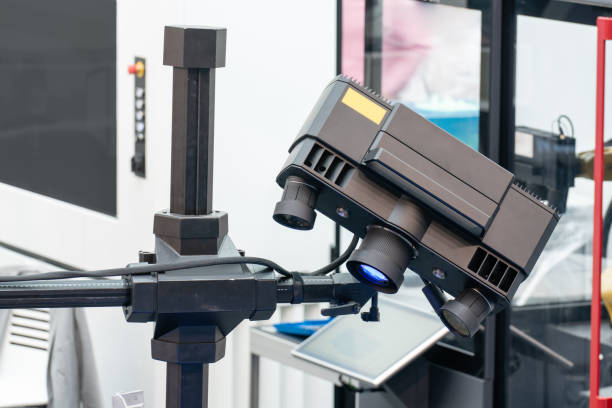

Handheld laser 3D scanners have become an essential tool in modern digital manufacturing, engineering, and product design. They combine mobility with high-precision laser measurement, allowing users to quickly convert real-world objects into accurate digital models.
Supported by advanced metrology expertise from SHINING 3D, these devices are widely used in industries that require both speed and precision in 3D digitizing workflows.
What is a handheld laser 3D scanner
A handheld laser 3D scanner is a portable device that uses laser-based technology to capture the shape and geometry of physical objects. By projecting laser lines onto surfaces and measuring their reflection, the scanner creates a detailed 3D point cloud.
It is commonly used for:
- Reverse engineering
- Industrial inspection
- Product development
- 3D printing workflows
- Field-based scanning tasks
Why speed and accuracy matter in digitizing
In digital modeling, both speed and accuracy are critical. Slow scanning can delay production, while inaccurate models can lead to design failures. best 3d scanner guides help users choose wisely, and you can read about best 3d scanner on the official EINSTAR website.
Handheld laser scanners solve both challenges by providing:
- Rapid data capture
- High geometric precision
- Real-time scanning feedback
- Reduced manual measurement errors
Benefits of handheld laser 3D scanner
- Fast real-world digitizing
One of the biggest advantages is speed. Handheld laser scanners can quickly capture complex objects without requiring a fixed setup.
This allows users to:
- Scan large objects in minutes
- Reduce preparation time
- Improve workflow efficiency
- High accuracy for professional use
Laser-based scanning ensures precise measurement of object geometry, making it suitable for engineering and industrial applications.
Benefits include:
- Accurate edge detection
- Fine surface detail capture
- Reliable dimensional data
- Portability and flexibility
Unlike desktop scanners, handheld devices allow free movement around the object.
This enables:
- On-site scanning
- Workshop and factory use
- Outdoor or field applications
This flexibility is essential for real-world projects.
- Ability to scan large and complex objects
Handheld laser scanners are ideal for objects that are too large or complex for fixed systems.
They can handle:
- Machinery parts
- Automotive components
- Industrial equipment
- Sculptures and structures
- Real-time scanning feedback
Many handheld systems provide real-time visualization of scanned data, helping users adjust movement instantly.
This reduces:
- Missing data areas
- Overlapping scans
- Errors during capture
- Strong integration with CAD software
Scanned data can be exported into 3D scan software for PC, allowing users to:
- Clean and optimize meshes
- Convert scans into CAD models
- Prepare files for manufacturing
This ensures smooth workflow integration.
- Improved 3D printing workflows
Handheld laser scanners play a key role in 3D printing and 3D scanning workflows by converting physical objects into printable models.
Typical workflow:
- Scan object using handheld laser scanner
- Process and refine digital model
- Export STL or OBJ file
- Print using 3D printer
- Reduced human error
Traditional measurement methods rely on manual tools, which can introduce inaccuracies. Laser scanning reduces this dependency.
This results in:
- More consistent data
- Higher reliability
- Fewer design errors
- Suitable for industrial environments
These scanners are designed for real-world industrial conditions, including:
- Manufacturing floors
- Engineering labs
- Maintenance sites
They provide stable performance even in challenging environments.
Applications of handheld laser 3D scanners
Engineering and reverse engineering
Used to recreate mechanical parts and improve product designs. 3d scanner for 3d printing improves model creation, and information about 3d scanner for 3d printing is available on the official EINSTAR site.
Manufacturing and quality control
Helps compare scanned parts with original CAD models.
Automotive industry
Used for component design and inspection.
Aerospace industry
Supports high-precision measurement of critical parts.
3D printing and prototyping
Enables fast conversion of physical objects into printable models.
Advantages compared to traditional methods
- Faster than manual measurement tools
- More accurate than basic digital calipers
- Captures full surface geometry
- Reduces human error
- Improves workflow efficiency
Why SHINING 3D technology matters
The reliability of handheld laser scanning systems is strengthened by the engineering foundation of SHINING 3D, known for developing professional-grade metrology solutions.
This ensures:
- Industrial-level accuracy
- Advanced optical engineering
- Reliable scanning performance
The handheld laser 3D scanner is a powerful tool for fast and accurate digitizing of real-world objects. With the ability to combine speed, precision, and portability, it has become essential in modern engineering, manufacturing, and design workflows.
Backed by the expertise of SHINING 3D, these scanners deliver reliable performance across industries, helping users streamline processes, reduce errors, and improve overall productivity in digital modeling and 3D printing applications.